
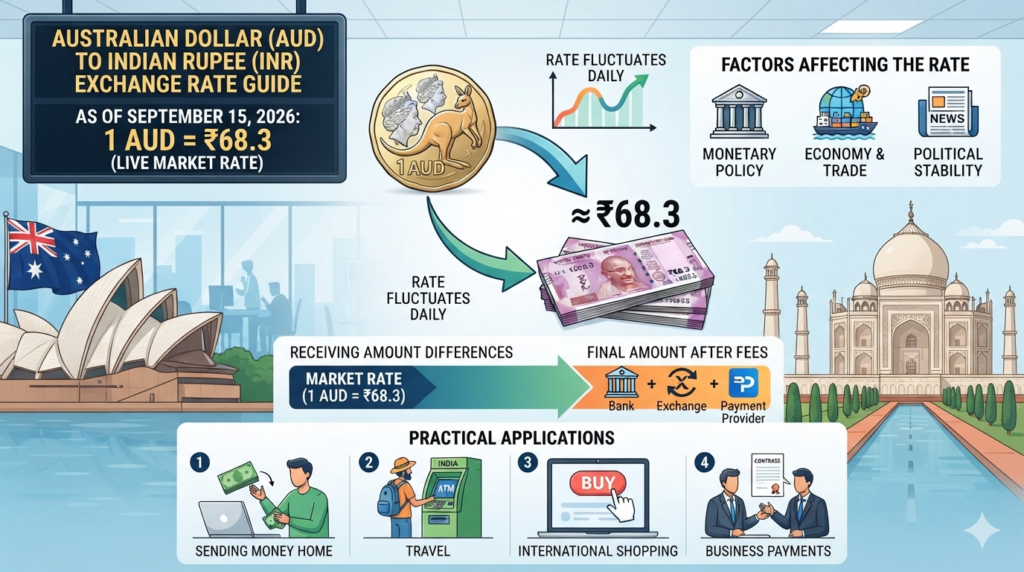

If you need to convert Australian Dollars into Indian Rupees, understanding the AU to INR rate is important. The exchange rate tells you how many Indian Rupees you can receive for one Australian Dollar. This rate changes throughout the day because currency markets are always moving. As of September 15, 2026, live market sources place the rate around ₹68.3 for 1 AUD. The final amount you receive can still differ from the market rate. Banks, exchange services, and payment providers may add fees or margins. This guide explains how AUD and INR work together. You will also learn simple conversion methods, rate factors, and practical examples. Whether you are sending money, traveling, shopping, or managing business payments, this information can help you make better decisions.
What Does AU to INR Mean?
AU to INR means converting Australian Dollars into Indian Rupees. AUD is the official currency code for the Australian Dollar. INR is the official currency code for the Indian Rupee. In the AUD/INR currency pair, AUD is the base currency. INR is the quoted currency. Therefore, a rate of ₹68.3 means one Australian Dollar is worth about ₹68.3. The rate can move higher or lower during the trading day. This happens because currency prices respond to economic news and market demand. When the AUD becomes stronger against the INR, one Australian Dollar buys more rupees. When AUD weakens, it buys fewer rupees. Understanding this simple relationship makes currency conversion much easier. It also helps you compare rates before sending or exchanging money.
Current AU to INR Exchange Rate
The current AU to INR market rate is around ₹68.3 per Australian Dollar on September 15, 2026. Different market platforms show small differences because prices update at different times. For example, recent live sources show rates around ₹68.23 to ₹68.42. This means 100 AUD is roughly equal to ₹6,830 before fees or exchange margins. However, this is a market reference rate rather than a guaranteed bank payout. Your actual conversion may be lower or higher. Always check the rate offered by your bank or money-transfer service before completing a transaction. Exchange rates can also change quickly. For this reason, avoid relying on an old screenshot or previous conversion. A live converter is usually better when you need an accurate current estimate.
AU to INR Conversion Table
| Australian Dollar (AUD) | Approximate Indian Rupees (INR) |
|---|---|
| 1 AUD | ₹68.30 |
| 5 AUD | ₹341.50 |
| 10 AUD | ₹683.00 |
| 20 AUD | ₹1,366.00 |
| 50 AUD | ₹3,415.00 |
| 100 AUD | ₹6,830.00 |
| 250 AUD | ₹17,075.00 |
| 500 AUD | ₹34,150.00 |
| 1,000 AUD | ₹68,300.00 |
| 2,000 AUD | ₹136,600.00 |
| 5,000 AUD | ₹341,500.00 |
| 10,000 AUD | ₹683,000.00 |
Values are illustrative using approximately ₹68.30 per AUD. Actual rates change.
How to Calculate AU to INR
Calculating AU to INR is simple when you know the current exchange rate. You multiply the Australian Dollar amount by the AUD/INR rate. For example, suppose the rate is ₹68.30. If you have 100 AUD, multiply 100 by 68.30. The result is ₹6,830. If you have 500 AUD, the calculation becomes 500 × 68.30. That gives approximately ₹34,150. The formula is easy: AUD amount × AUD/INR rate = INR amount. Remember that this calculation normally represents the market value. A bank or transfer company may use a different customer rate. It may also deduct a transaction fee. Therefore, use the calculation as an estimate. Always check the final amount before confirming your transfer or currency exchange.
AUD to INR Converter: How It Works
An AUD to INR converter helps you calculate the value of Australian Dollars in Indian Rupees. You enter an AUD amount, and the tool applies the current exchange rate. Most modern converters can also convert INR back into AUD. Some tools update their rates frequently during the day. For example, one current converter reports updates at regular intervals. This makes online converters useful for quick estimates. However, you should understand that a converter may show a mid-market rate. Your bank may not offer that exact price. The difference can come from spreads, service charges, or transfer fees. Therefore, use a converter for planning. Then check the provider’s final quote before sending money. This approach gives you a clearer picture of your real costs.
Why Does the AUD to INR Rate Change?
The AU to INR rate changes because both currencies respond to economic conditions. Interest rates are one important factor. Central-bank decisions can influence investor demand for a currency. Inflation can also affect currency values over time. Commodity prices matter to Australia because the country has a large resource-based economy. Conditions in India’s economy can also influence the Indian Rupee. Global investor sentiment plays another role. When investors become nervous, money can move between currencies and markets. Oil prices can also affect the Indian Rupee because India imports large amounts of energy. Recent reports have highlighted pressure on the rupee from higher global oil prices. These factors explain why an exchange rate today may look different tomorrow.
AUD to INR Rate for 100 AUD
If you have 100 Australian Dollars, the calculation is straightforward. Using an illustrative rate of ₹68.30, 100 AUD equals approximately ₹6,830. This amount represents the exchange value before fees and provider margins. Your bank could offer a slightly different amount. For example, the provider may use a customer rate below the mid-market price. A fixed transfer fee could also reduce the final amount. This is why comparing providers matters when transferring larger amounts. A small rate difference can become significant on large transactions. For example, a difference of ₹1 per AUD creates a ₹1,000 difference on a 1,000 AUD transfer. Checking the rate before making a transaction can therefore save money. It only takes a few minutes but can make a meaningful difference.
AUD to INR Rate for 1,000 AUD
For larger conversions, even a small rate movement can affect the final amount. At an illustrative rate of ₹68.30, 1,000 AUD equals about ₹68,300. If the rate rises to ₹69, the same amount becomes ₹69,000. That creates a ₹700 difference without changing the Australian Dollar amount. This example shows why businesses and frequent travelers often monitor currency markets. People receiving salaries or payments from Australia may also watch the rate closely. The best rate depends on your specific timing and needs. Waiting for a better rate can sometimes help, but currency movements are unpredictable. Nobody can guarantee that a rate will improve tomorrow. If the transfer is important, compare the available rates and fees instead of trying to predict the perfect market moment.
What Affects Australian Dollar and Indian Rupee Values?
Several factors influence the AUD/INR exchange rate. Australian interest rates can affect demand for the Australian Dollar. Indian interest rates can influence demand for the Rupee. Economic growth also matters in both countries. Commodity prices can influence Australia’s export earnings. Oil prices can create pressure on India’s import costs. Global risk sentiment is another major factor. Political developments, inflation reports, employment data, and central-bank announcements can create short-term movements. The relationship between major currencies can also affect AUD/INR indirectly. For example, movements in the US Dollar can influence both currencies. Recent Indian currency reports have shown how oil prices and expectations around US interest rates can pressure the rupee. Because these factors constantly change, there is no permanently fixed AUD to INR rate.
Mid-Market Rate vs Bank Exchange Rate
The mid-market rate is often used as a reference for currency conversion. It represents a market-based rate between buyers and sellers. However, customers rarely receive the exact mid-market rate from every provider. Banks and transfer companies may add a markup to their exchange rate. They may also charge a separate transaction fee. This means two providers can offer different INR amounts for the same AUD payment. When comparing services, do not look only at the advertised rate. Check the final amount that the recipient will receive. For example, a provider offering a slightly better rate may charge a larger fee. Another provider may offer a lower fee but a weaker exchange rate. Comparing the complete transaction cost gives you a more accurate result. This is especially important for large international transfers.
How to Get a Better AUD to INR Conversion
Getting a better AU to INR conversion starts with comparing multiple providers. Do not automatically use the first exchange service you find. Check the live rate, transfer fee, and final recipient amount. Also check whether the provider charges additional receiving fees. For larger transfers, even a small exchange-rate difference can matter. Timing can also affect your result because currency markets move constantly. However, trying to predict the exact best moment is difficult. Instead, focus on transparent pricing and low overall costs. If you regularly transfer money, monitoring the rate can help you recognize normal market movements. You can also set alerts through some financial platforms. Most importantly, avoid judging a service by its headline rate alone. The amount actually received is the number that matters.
AUD to INR for Travelers
Travelers may need Australian Dollars converted into Indian Rupees for hotels, food, transport, and shopping. Before traveling, checking the current exchange rate can help create a realistic budget. However, cash exchange counters may offer different rates from online market prices. Card providers can also use their own exchange rates and fees. Some cards charge foreign transaction fees, while others offer more competitive currency conversion. ATMs may also charge withdrawal fees. Therefore, travelers should understand their payment options before leaving Australia. Carrying some local currency can be useful for smaller purchases. At the same time, using a trusted card can reduce the need to carry large amounts of cash. Always check your provider’s fees. A good travel budget should consider both the exchange rate and the extra costs attached to each payment method.
AUD to INR for International Money Transfers
International transfers are another common reason people check AU to INR rates. Australians may send money to family, pay for services, support education, or handle business expenses in India. The exchange rate can have a large effect on the recipient’s final amount. When comparing transfer services, look at three things. First, check the exchange rate. Second, check the transfer fee. Third, check the final INR amount received. Some providers advertise low fees but make money through exchange-rate margins. Others may charge a visible fee while offering a stronger rate. Processing time can also matter. A cheaper transfer may not always be the best option if it takes much longer. Always review the complete transaction details before confirming your payment.
Understanding AUD/INR Historical Rates
Historical rates help you understand how a currency pair has moved over time. They can show whether the Australian Dollar has recently strengthened or weakened against the Indian Rupee. For example, recent September data has shown AUD/INR trading around the upper ₹67 to ₹68 range. Looking at historical data can provide useful context. However, past performance does not guarantee future results. Currency markets can react quickly to unexpected events. Historical charts are therefore best used for understanding trends rather than predicting exact future prices. If you are planning a large transfer, compare recent rates with today’s rate. You can also look at weekly or monthly ranges. This gives you a broader view than checking one number from one day.
Common Mistakes When Converting AUD to INR
One common mistake is assuming that the online rate is the final rate. Market converters often show reference or mid-market pricing. Another mistake is ignoring transfer fees. A provider with a lower fee can still be expensive if its exchange rate is poor. People also sometimes compare only the amount of AUD they send. The more important figure is the INR amount received. Another mistake is using outdated rates from old articles. Currency prices change every day. It is also risky to assume that tomorrow’s rate will definitely be better. Exchange markets are unpredictable. Finally, avoid sending money through an unfamiliar provider simply because it shows an attractive rate. Check its reputation, security features, terms, and customer support. A slightly better rate is not worth unnecessary risk.
Why the AUD/INR Rate Matters to Businesses
Businesses working between Australia and India may closely watch the AU to INR exchange rate. Importers and exporters can face currency risk when invoices are paid in different currencies. A change in the exchange rate can increase or decrease business costs. Freelancers receiving Australian payments may also notice changes in their income after conversion. The same applies to companies paying overseas contractors. Businesses can reduce surprises by tracking currency movements and planning payment schedules carefully. Some companies use financial tools to manage currency exposure. Larger organizations may also discuss hedging strategies with qualified financial professionals. Small businesses should at least include exchange-rate changes in their budgets. A payment that looks profitable at one rate may become less attractive after a major currency movement. Good planning can help protect cash flow.
Simple Formula for AUD to INR Conversion
The easiest conversion formula is simple. Multiply the Australian Dollar amount by the current AUD/INR exchange rate. For example, if the rate is ₹68.30, then 250 AUD × 68.30 equals ₹17,075. This gives you an estimated INR value before fees. To convert INR back into AUD, divide the INR amount by the AUD/INR rate. For example, ₹68,300 divided by 68.30 equals 1,000 AUD. These calculations are useful when planning budgets and transfers. Still, the final amount can differ from your calculation. Your provider may use a different customer rate. It may also charge a transaction fee. Therefore, treat the formula as a planning tool. Always confirm the final quote before completing an actual currency exchange.
Frequently Asked Questions About AU to INR
What is the current AU to INR rate?
The live market rate is around ₹68.3 for 1 Australian Dollar on September 15, 2026. Rates can change throughout the day.
How much is 100 AUD in INR?
At an illustrative rate of ₹68.30, 100 AUD equals approximately ₹6,830. Your actual amount may differ because of provider fees and exchange margins.
How much is 1,000 AUD in Indian Rupees?
Using ₹68.30 per AUD, 1,000 AUD equals approximately ₹68,300. The final amount depends on the provider’s customer rate.
Is the AUD to INR rate fixed?
No. The AUD/INR exchange rate changes as currency markets move. Economic data, interest rates, oil prices, and global sentiment can all affect it.
Where can I check the AUD to INR rate?
You can use a reputable live currency converter or financial market platform. Compare the displayed market rate with your bank’s actual customer rate before transferring money.
Is the online AUD to INR rate the same as my bank rate?
Not always. Online converters may show a mid-market rate. Banks and money-transfer services can add exchange-rate margins and transaction fees. Always check the final amount you will receive.
Conclusion
The AU to INR exchange rate is useful for travelers, families, freelancers, businesses, and international shoppers. It tells you how many Indian Rupees one Australian Dollar can buy. Current market sources place the rate around ₹68.3 per AUD on September 15, 2026. However, the rate you actually receive may differ. Provider margins, transfer fees, and market movements can all change the final amount. The smartest approach is to check a live rate and compare the total cost. Do not focus only on the advertised exchange rate. Look at the final INR amount received. If you regularly exchange currencies, tracking the AUD/INR trend can also help with planning. Use the conversion formula and table above for quick estimates, then confirm the final rate before making your transaction.